

How to Close the Books Faster — Without Cutting Corners
Nov 05, 2026
A practical, step-by-step guide to a faster month-end close: where to speed up, where AI helps, where human oversight stays non-negotiable, and how platforms like SAP Concur make a faster close possible. Free checklist included.
Every finance team I’ve worked with in Canada wants the same thing: a faster month-end close, with reporting ready in time to actually inform a decision, not weeks after it’s already been made. What stops organizations from being able to achieve this is often the same recurring problem. In SAP Concur’s latest CFO Insights, 38% of finance leaders now name manual processes as a top internal challenge — up from just 1% the year before, the single biggest year-over-year jump the survey has ever recorded. The manual grind is the operational behavior that is standing between them and a faster close.
The gold standard for a close is three to four days — I’ve had clients do it in one. But many still average seven to fourteen, which is too long, and too far into the following month, to add the value it should.
The hurdle for most is believing they have to trade speed for accuracy. “Faster” should never mean a restated number, a missed accrual, or entries that trigger questions from the auditor three months later. When the close process and the underlying systems are built right, that trade-off fades away.
A slow close isn’t a careful close; it’s usually just a manual one — where you’re examining every transaction, living in Excel, and sifting through email after email to close the approval loops. The teams that close fastest didn’t cut corners. They removed the busywork that was never really a control, just an efficiency bottleneck, and put their judgment where it actually matters, and where AI can’t step in.
I’m sharing a step-by-step close process: where automation can safely speed things up, and where a human has to stay in the loop to provide the oversight this critical process needs. There’s a downloadable checklist at the end you can keep by your desk and put to work on your next close.
What does “closing the books” actually mean?
Month-end close is the process of reviewing, reconciling, and finalizing all of a company’s financial transactions for the month so it can produce accurate financial statements. It runs from the transaction cutoff, the last day to enter, through reconciliation, adjusting entries, review, and sign-off, ending with reporting to leadership.
Done well, the close is what makes every downstream number trustworthy: the board report, the cash forecast, the tax filing. Done poorly, every one of those inherits the same errors — and the questions that follow.
How long should a month-end close take?
Benchmarks vary, but the research is consistent on one thing: the gap between fast and slow teams is wide. According to APQC’s benchmarking of roughly 2,300 organizations, top-performing finance teams close their books in about 4.8 days or fewer, while the slowest take 10 days or more. Ventana Research has found that only around half of businesses — roughly 53% — complete their monthly close within six business days.
So, if your close takes a week and a half, you’re not failing, you’re average. But “average” is a lot of days your team spends looking backward instead of forward, and that’s where the value is lost. A realistic target for most private companies is five to seven calendar days, and the strongest teams aren’t adding headcount, they’re removing manual steps.
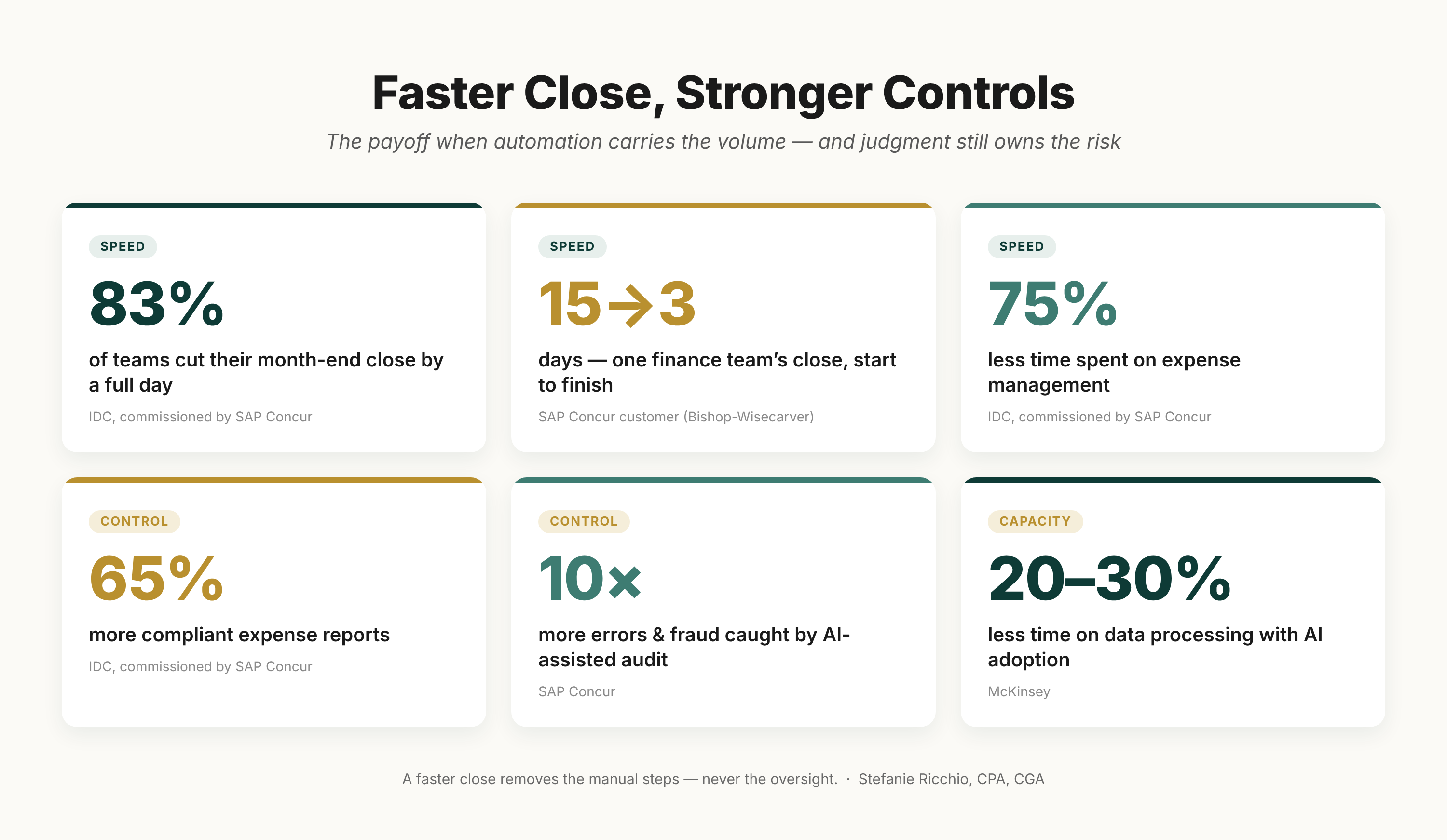
In IDC research commissioned by SAP Concur, 83% of organizations using Concur cut their month-end close by a full day, efficiency and controls intact. That’s the end game: speed that comes from removing manual work, not from skipping steps.
A slow close isn’t a careful close. It’s usually just a manual one.
Why faster doesn’t mean sloppier
There’s a misconception in finance that slowing down is how you catch mistakes. In reality, the manual steps; re-keying data, chasing receipts over email, eyeballing a sample of transactions, are where most errors are introduced, not caught. A person reconciling hundreds of lines of data is not your strongest control. Automation is.
It’s the whole premise behind platforms like SAP Concur for travel and expense management: the control runs continuously, inside the system, throughout the month — not in a frantic sweep at close. That matters because visibility is scarce. Only 30% of finance leaders say they have complete visibility over their spend (SAP Concur CFO Insights), as finance leaders we know that you can’t close quickly on numbers you can’t see.
Done right, a faster close means fewer hands touching the data, fewer places for it to break, and more time for the review that genuinely requires human oversight and context. The goal isn’t to rush the close. It’s to spend your limited human attention on the 10% that truly needs judgment.
How to close the books faster: the step-by-step process
Here’s the close broken into ten phases. For each, the question is simple: can this be automated, or does it need a human? (The downloadable checklist tags every task either way.)
- Prepare before the clock starts ticking
Publish a close calendar; every task, owner, deadline and gather outstanding receipts and invoices before day one.
- Capture and lock the cutoff
Record all revenue, expenses, corporate-card activity, and payroll, then enforce the cutoff so nothing from next period leaks in. When spend is captured continuously through a platform like SAP Concur, this step is already most of the way done before close even begins. Data capture is highly automatable; the cutoff judgment call is not.
- Reconcile
Bank accounts, corporate cards, AR and AP sub-ledgers, intercompany. This is the single biggest time sink in most closes and the one automation compresses most dramatically, by matching transactions in the background and surfacing only the exceptions.
- Check expenses against policy
Every expense report should be checked against policy; ideally all of them, not a sample a human had time to spot-check. This is exactly what SAP Concur runs automatically, testing every report and routing only the flagged exceptions to a person to resolve. It shows up in the numbers: Concur users report 65% more compliant expense reports (IDC).
- Book accruals and adjusting entries
Accruals, prepaids, deferrals, depreciation. Routine entries can be automated, set it and forget it. Estimates and accruals need professional judgment and should stay with your team.
- Review the balance sheet
Substantiate every balance-sheet account and clear aged or suspense items. This review work is for the team to execute.
- Run variance analysis
Compare actuals to budget and prior period. The system can surface the variances instantly; explaining why they happened is the team’s job.
- Review and sign off
A controller or manager reviews the full close package, and nothing is finalized without documented approval. This always lands with the senior finance person.
- Report and distribute
Generate the statements and management reporting, then distribute to leadership with commentary. Reporting generates itself; the commentary belongs to finance leadership to provide and contextualize.
- Run a post-close review
The step everyone skips: log what broke or ran late, and pick one thing to fix before next month. A close gets faster one cycle at a time.
Automation, AI, and where human oversight isn’t optional
This is where a modern close genuinely pulls ahead and where it’s easiest to get wrong. Used well, AI and automation take over the high-volume, repetitive work that burns out your team and introduces errors. McKinsey has found that finance teams which have adopted AI meaningfully spend 20–30% less time on data processing, time that moves straight into analysis and review.
And adoption has accelerated fast. In SAP Concur’s CFO Insights, 57% of general finance tasks are now highly automated by AI — up from just 7% a year earlier, and 94% of finance leaders say AI has already improved their decision-making. This is the capacity most teams say they never had time to build and are implementing at rapid paces.
What AI and automation can own
- Transaction capture — pulling in expenses, receipts, and card activity without manual entry.
- Reconciliation matching — clearing the thousands of routine matches and surfacing only what doesn’t tie out.
- Policy checks — testing every transaction against the rules, not a sample.
- Anomaly flagging — catching the duplicate, the outlier, the out-of-policy charge a tired human would miss. AI-assisted audit catches up to 10x more errors and fraud than manual review and cuts audit time by as much as 90%.
What has to stay human
- Estimates and accruals — anything requiring professional judgment about the future.
- Exceptions — the flagged items a machine surfaces but can’t resolve.
- Materiality calls — deciding what matters and what doesn’t.
- Final review and sign-off — the buck stops with a person, every time.
Automation handles the volume. Judgment handles the risk. The human-in-the-loop isn’t a nice-to-have — it’s the control.
The best setups make this division invisible. The repetitive work happens in the background, and people only see what needs a decision. It’s why platforms like SAP Concur have become part of the close for so many teams: expense and travel data is captured and policy-checked as it happens, so the data is ready when month-end arrives instead of being chased down after it.
The results are concrete. Bishop-Wisecarver took its month-end close from 15 days down to 3. Closer to home, BrettYoung, a Canadian agriculture business, cut expense reporting from half a day to 15 minutes and saved 200 hours a year in a single department. The point was never to take accountants out of the close. It was to stop making them do the work a machine does better, so their judgment lands where it actually adds impact.
Common mistakes that quietly slow your close
- Starting the chase on day one instead of before cutoff — you’re already behind.
- Reconciling everything by hand when matching is the most automatable step you have.
- Spot-checking expenses and hoping the sample was representative.
- Re-keying data between systems — every manual transfer is an error waiting to happen.
- Skipping the post-close review, so the same bottleneck returns every single month.
The bottom line
Closing faster isn’t about working longer hours or taking on risk. It’s about removing the manual steps that felt like controls but were really just making close harder, letting automation carry the volume, and spending your team’s judgment where it actually moves things forward. Do that, and a five-day close stops being aspirational and starts being an achievable target.
This article is created in paid partnership with SAP Concur. See how SAP Concur helps finance teams close faster with control
Download your FREE month-end checklist